Thursday, September 8, 2011

par holidays

holiday places in Paris, cheap hotels in Paris
holiday rental paris

bathroom


baby bedroom

Paris lounging area

old paris story


private terrace

Sunday, August 7, 2011

how to find a cheap hotel in Paris


Cheap hotels in Paris: prefer booking online!
The central hotel reservation in Paris save you valuable time, but the extra cost of up to 15% or 20% per room per night! Therefore if the price factor is important to you, is two solutions. The first is to methodically peeling the web (or the yellow pages) to inquire about prices and you provide a list of cheap hotels in Paris. An effective but extremely time-consuming given the number of competing institutions and therefore the time it takes to devote to your search!Fortunately there is another way to list the cheap hotels in Paris. Your budget hotel in Paris
 with a few clicks, you can! 


Budget hotel room in Paris, france 
last minute room reservation Paris


Paris france hotel room

view from budget hotel paris

Cheap hotels in Paris: prefer booking online!
The central hotel reservation in Paris save you valuable time, but the extra cost of up to 15% or 20% per room per night! Therefore if the price factor is important to you, is two solutions. The first is to methodically peeling the web (or the yellow pages) to inquire about prices and you provide a list of cheap hotels in Paris. An effective but extremely time-consuming given the number of competing institutions and therefore the time it takes to devote to your search!Fortunately there is another way to list the cheap hotels in Paris. Your budget hotel in Paris
with a few clicks, you can!
Pressed for the user looking for a cheap hotel in Paris, there are sites offering centralized commission without passing on the price paid by the user. These sites operate on a different model, halfway between a directory and a central reservation. On these sites you will find lists of hotels with comprehensive tracking map, an indication of prices and information services. The difference with a central hotel reservation? These platforms encourage the user to visit the official website of the hotel, although they also offer a service to hurry reservation of their own. A list of hotels in Paris complete and no additional cost to the user.
These sites have their very competitive compensation package with a fixed applied to each institution, so the exit commissions to sales made. The benefit for the user is in point: a list of hotels in Paris made synthetically, relevant and consistent with rates fares "direct" posted on the official website of each institution. The warranty for the user to find a cheap hotel in Paris a few clicks.

Cheap hotels in Paris: prefer booking online! 

The central hotel reservation in Paris save you valuable time, but the extra cost of up to 15% or 20% per room per night! Therefore if the price factor is important to you, is two solutions. The first is to methodically peeling the web (or the yellow pages) to inquire about prices and you provide a list of cheap hotels in Paris. An effective but extremely time-consuming given the number of competing institutions and therefore the time it takes to devote to your search!Fortunately there is another way to list the cheap hotels in Paris. Your budget hotel in Paris with a few clicks, you can!
Pressed for the user looking for a cheap hotel in Paris, there are sites offering centralized commission without passing on the price paid by the user. These sites operate on a different model, halfway between a directory and a central reservation. On these sites you will find lists of hotels with comprehensive tracking map, an indication of prices and information services. The difference with a central hotel reservation? These platforms encourage the user to visit the official website of the hotel, although they also offer a service to hurry reservation of their own. A list of hotels in Paris complete and no additional cost to the user.
These sites have their very competitive compensation package with a fixed applied to each institution, so the exit commissions to sales made. The benefit for the user is in point: a list of hotels in Paris made synthetically, relevant and consistent with rates fares "direct" posted on the official website of each institution. The warranty for the user to find a cheap hotel in Paris a few clicks.

Thursday, June 9, 2011

interesting information: cost of living in paris

Cost of living in Paris


How much do things cost in Paris... an idea:

The metro is one of the least expensive and certainly the best network in the the world. A book of 10 tickets will cost you approximately €10.


Here are some average prices for everyday consumer products:

1 full-price museum admission: €7 to €9.
1 sandwich: around €5.
1 pizza: between €8 and €10
1 small coffee: €1 at the bar, €2 sitting down
1 full meal (starter, main dish, dessert, not including drinks): between €15 and €20 depending on the area.
1 baguette of bread: €0.80
1 beer in a café: €2 to €4
1 seat at the cinema: €9

Going out?

A ticket for the Parisian underground costs €1.40
A litre of unleaded 95 petrol costs more than €1.45
To a see a film will cost between €8 and €10
To attend a concert of a well known artist, you should allow €40 on average
A ticket to visit the Louvre costs €8.50.
To go up to the top of the Eiffel Tower by lift will cost €11.50

how to get a French Carte de Séjour

French Residency: The Carte de Séjour
Everyone's situation is different, and immigration laws change constantly therefore the following should be taken as a rough guide to what you can expect. Please contact us if you have specific questions regarding your requirement for a visa or permit.
Non EU citizens
Unless you are a citizen of the European Union, you will need to contact the French Embassy/Consulate of your current country of domicile BEFORE you arrive to ensure you are arriving in France on the correct visa. Without the correct Visa applying for residency can become an even more complicated matter.
Some people arrive on a tourist visa and start to process their application for residency once in France, - this is often the case when employees are paid in their home country. This is possible but can delay things considerably as the carte de séjour is required for many other administrative procedures.
Procedures may vary for different nationalities and activities, therefore it is important to clearly explain to your French embassy your intended plans. Starting the ball rolling at home will help things along once you arrive in France.
It is also important at this stage to let them know who will be accompanying you and whether they have a requirement to work, study etc., during their stay in France.
You will also be required to undergo a medical examination with the OMI - Office des Migrations Internationales before your residency application is accepted.
The whole process may take several months so patience is needed, once you are a resident in France you will have many of the same social rights as a French national.
EU Member
If you hold a passport for one of the member states of the European Union, you are permitted to reside in France on your passport. Since November 2003 Eu members no longer require a carte de séjour.
Practically France is still in transition with this new situation and you may find that you require one for certain administrative procedures relating to employment and registrations while other administrative bodies adjust their procedures.
Obtaining the Carte de Séjour
The residency permit may vary in its validity and this will depend on the nature of your work contract or personal situation.
The minimum documents you will require in order to obtain a Carte de Séjour are included in the following list.
*Please note that, depending on your working/marital situation, you may be required to provide additional information:
For You:
1) Completed application form (provided by immigration services)
2) Photocopy of the title pages of your Passport
3) 3 ID photographs (black and white - no head clothing, sunglasses etc.)
4) Declaration d'engagement (should be completed by your employer)
5) Proof of French address (utility bill, lease less than three months old)
6) If you are paid abroad: Health insurance, E101

For your Partner:
1) Marriage Certificate (officially translated into French)
2) Completed application form (provided by immigration services)
3) Photocopy of the title pages of your Passport
3) 3 ID photographs (black and white - no head clothing, sunglasses etc.)
4) Declaration d'engagement (should be completed by your employer)
5) Proof of address (utility bill, lease less than three months old)
NB: Originals AND photocopies should be presented for each individual, translated documents must be translated by an officially recognised translator and be accompanied with originals and photocopies. Each persons application is processed independantly.
The process takes around 2-3 months depending on the time of year and the department you live in.
Intransit are able to assist in all immigration matters.

tips for moving in paris: opening a bank account

Whether you are resident or non-resident you are entitled to open a bank account in France.

Neither do you need to own a home in France to open a French bank account.

If you are non-resident then you would open a compte non-résident.

However, whilst residents have an automatic right to a bank account, this is not the case for non-residents.

You are likely to find that the rules governing the operation of the account as a non-resident are tougher, such as the need to maintain a minimum deposit, and limits on the amount you may be able to transfer each month.

Few High Street French banks will allow you to open an account as a non-resident without actually presenting yourselves in person to them. This is because of the legal obligations imposed upon banks concerning the control of money laundering.

That said, it is possible for residents of the UK and Ireland to open a Crédit Agricole Britline account by post, with CA Normandie.

Most of the Internet Banks also allow non-residents to open an account, but check with them on their residence qualification, if any. Once again, however, expect to have to provide a lot of paperwork to be able to do so.

If you want to remain discreet you can open an account using a pseudonym, provided you are resident, and provided the bank is satisfied about who you really are!

Similarly, a woman, if she so wishes, can open an account using her maiden name.

However, do not assume you can run a secret bank account in France.
The French tax and other regulatory authorities maintain a list of all bank accounts held in France, through a registration system called FICOBA - Fichier national des comptes bancaires et assimilés.
This system only provides summary details of the account holder and type of account; it does not provide them access to the operations of the bank account.

Business accounts held in the name of the company are also on the system.

The banks are also required to inform the tax authority of the closure of an account, or change of account holder, and to inform them of funds in the account of a deceased person.

Since 2010 notaires have access to this system, so that they can deal more effeciently with inheritance, divorce and other cases handled by them.

The level of monitoring of customer withdrawals and transactions by the banks themselves has increased significantly in recent years, with the banks required by law to notify the regulatory authorities about 'suspicious' transactions.

your friends are coming to visit: 10 things to do with them

1. Bateaux Mouches

The Bateaux Mouches (boat excursions on the Seine) are a fantastic way to discover Paris in an hour or more. They can also be extremely romantic. They will take you on a ride along the Seine, allowing you to discover the beauty of the monuments standing on its banks and the exquisite bridges it flows under. Truly a beautiful experience any time of the year.
Price:8 Euros (about $12.00) and up.

2. Champs Elysees and Arc de Triomphe

The Arc de Triomphe stands in the middle of the "Place de L'Etoile" (Star Place) named after the star shaped design of the cobblestones surrounding the Arc. You can climb the stairs to the roof for a breathtaking view of Paris' rooftops and the 5 avenues each departing from the tips of the star. One on these avenue is the Champs Elysees which offers a variety of shops and restaurants. The Arc also holds a museum, mostly dedicated to Napoleon the tomb of the French Unknow Soldier.
Price 8 Euros(about $12.00), open daily from 10:00am-11:00pm

3. Eiffel Tower

Built in 1889 by Gustave Eiffel for the Universal Exhibition, the Eiffel Tower commemorates the 100 year anniversary of the French Revolution. Now one of the most well know monuments in the World, you can climb its 1652 steps, or take an elevator, to see the most breathtaking view from the top. Really great to do around 4pm in the winter month and wait for the sun to set over Paris. The first floor host one of the greatest restaurant in Paris "The Jules Verne" where reservations must be made, pricey but worth the experience.
Prices vary from 3,80 to 11,00 euros ($4.50 to $13.00), open daily from 9:30am to Midnight.

4. Les Invalides

Ordered by Louis XIV in 1670 as an old soldiers home, the Invalides include 4 separate museums; Army Museum, the Museum of Maps, Museum of the Liberation Order and Contemporary History Museum. You'll also find the St-Louis-Des-Invalides Church, where Napoleon Bonaparte is buried. A great museum of history of France's battles and army men, kings and emperors, this is a must visit.
Open daily from 10:00am-5:00PM

5. Le Louvre

The Louvre is first home of the Kings of France. Now a museum, it holds an amazing permanent collection of French art (paintings, furniture etc...) and also hosts grandiose exhibitions from around the world. The museum is enormous and will take more than one day to visit if one wanted to explore every corner of it. There is also a shopping mall underneath the museum.
Prices vary from 8,50 euros to 11,00 euros (About $10.00 to $13.00), open daily from 9:00am-6:00pm, closed Tuesdays and holidays, open 'til 9:45PM on Thursdays.

6. Montmatre et Sacre Coeur

This little village perched on the hill in the north of Paris is an artist's paradise. With the Moulin Rouge at its feet and the Sacre Coeur Basilica on its very top, this hill holds many splendors. One can walk around the village all day discovering its cafes and restaurant, narrow streets and artists.
Basilica is free to visit and is open daily from 6:45am to 11:00pm

7. Notre Dame de Paris Cathedral

Home of the "Hunchback", this cathedral is spectacular. Its restoration, completed a shot time ago makes it a jewel standing on along the Seine. A short walk away, you can visit les Halles, pedestrian only maze of eclectic shops and restaurants. There you will also find the Pompidou Center which holds the National Museum of Modern Art and the Beaubour Library.
Free, donations accepted. Open from 6:00am to 11:00pm

8. Quais de la Seine

Bordering the Seine, starting across from Notre-Dame are a series of "bouquinistes" (book sellers) where one can find treasures to take home. You will find old book and magazine prints, old postcards and pictures, art prints and paintings. You can descend the nearby stairs for a walk on the river's banks.

9. The Opera

Home of the "Phantom", the Opera Garnier is a monument that can not be missed. One can still enjoy miraculous operas or classical concerts in the walls of this 19th century accoustic treasure.

10. Tuileries Gardens, Place de la Concorde

The Tuileries, the Louvre's gardens include many sculptures and fountains as well as cafes and restaurants. At the doors, you will find a Ferris wheel which was erected for the 2000 New Year's Eve. At its feet, lies The Place de la Concorde, the largest place in Paris, with its many has been completely renovated and in the middle of it is the famous Obelisk of Luxor, given to the King Louis Philippe by Mohamed Ali, viceroy of Egypt.

Paris louvre France


Discover the Louvre

From its beginnings as a royal fortress to the public institution we see today, discover the Musée du Louvre: its role, its aims, and the expertise of the people who make it work.


Some of the most famous works of art in the museum are the Venus of Milo, the Nike of Samothrake, the Dying Slave by Michelangelo and of course Leonardo da Vinci's Mona Lisa.

History of the Louvre
The Louvre was created in several phases.
Musée du Louvre
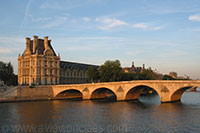
Louvre seen from across
the Seine
Originally built as a 12th century fortress, it was converted into a royal palace in the 14th century.

Its current appearance goes back to the 15th century, when the original fortress was demolished and the wing along the Seine river was built. The palace was extended during the 16th century by architect Pierre Lescot, who expanded the palace into a complex with two courtyards. A decade later Catharina de Medici added the Tuileries palace to the west of the Louvre. Construction on the Louvre was halted for some time when king Louis XIV decided to move to versailles
In the 19th century, during the Second Empire, the Louvre was expanded again with the addition of the Richelieu wing.
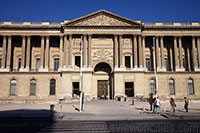
East Wing, Louvre Museum
East Wing
The Louvre now had four symmetric wings surrounding a large courtyard. This would not last long, as the Communards burned the Tuileries palace in 1871, opening up the west side of the palace.

The collection of the Louvre Museum was first established in the 16th century by King Francis I. One of the works of art he purchased was the now famous Mona Lisa painting. The collection grew steadily thanks to donations and purchases by the kings. In 1793, during the French Revolution, the private royal collection opened to the public.

Glass Pyramid
The most recent addition to the Louvre was the
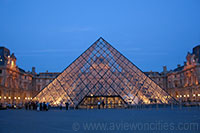
Louvre Pyramid
Louvre Pyramid
construction of the glass pyramid, which functions as the museum's main entrance. The pyramid was built in 1989 by the renowned American architect I.M. Pei. The glass pyramid allows the sunlight to come in on the underground floor.

The modern addition originally received mixed reviews, as it contrasts sharply with the classical design of the surrounding buildings, but today it is generally accepted as a clever solution which has given the museum a spacious central entrance without the need to touch the historic patrimony.
Cheap Paris hotels near louvre